August 10, 2026
Daily Communication in Senior Living Communities
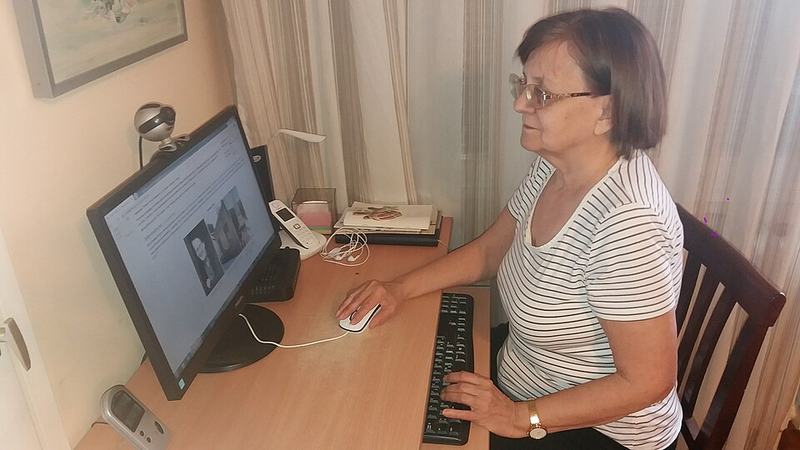
It doesn't take a complex study to sense it: feeling accompanied lifts mood, and mood affects physical health. But it's worth pausing on why daily communication specifically — not just the weekly visit — has such a marked effect on the well-being of people living in a senior living community.
The effect on the resident
Knowing the family is in the loop, even without being physically present, changes the experience of living in a community. It stops feeling like a place cut off from the rest of family life and becomes a connected space, where what happens day to day — a meal, an activity, a conversation — has an audience beyond the community's walls.
The effect on the family
On the family's side, frequent communication lowers the anxiety of uncertainty. Instead of imagining scenarios — often worse than reality — there's concrete, up-to-date information. This also indirectly eases the guilt of not visiting an aging family member often enough, because the relationship is sustained in other ways between one visit and the next.
The effect on the community
Communities that prioritize daily communication tend to get fewer calls from anxious families asking about their loved one — because they already have the information they need. This frees up real time for the care staff, a benefit we explore in depth in how communities can reduce administrative burden and improve care.
It also helps fight something deeper: how to prevent loneliness in older adults doesn't depend only on in-person activities, but on feeling part of a network that stays active even at a distance.
Ambiguous loss: being present and absent at the same time
Psychology describes as 'ambiguous loss' the experience of feeling that someone is still present but, at the same time, slipping away in ways that are hard to name — something that comes up often both in families of older adults living in senior communities and in those going through progressive cognitive decline. The uncertainty of not quite knowing 'how are they doing today' feeds this diffuse sense of loss, even when the person is alive and relatively well. Daily communication doesn't eliminate that ambiguity at the root, but it reduces it in practice: it replaces constant uncertainty with concrete, up-to-date information, even if brief, which in psychological terms significantly lowers the associated anxiety burden.
Social support theory explains a similar mechanism from another angle: it isn't only the support actually received that protects well-being, but the perception that support is available if needed. A family that gets daily updates, even routine ones, develops a sense of an active, available network that lowers stress — very different from depending on a phone call that isn't always possible to make or answer in time.
A benefit that reaches all three sides of the care triangle
It's worth thinking of caring for an older adult in a community as a triangle: the resident themselves, their family, and the care staff. Well-implemented daily communication isn't a benefit exclusive to just one of the three sides — it improves the resident's experience (they feel connected), lowers the family's anxiety (they have real information), and frees up staff time (fewer repetitive calls to answer). When a community thinks of communication only as an extra service for the family, it tends to underestimate this combined effect, which is actually where the biggest impact on the overall well-being of the care system lies.
Starting with realistic expectations
For families who've never had this kind of communication with a community, it helps to start with adjusted expectations: daily communication won't fix an already-strained family relationship, and it won't replace a hard conversation that needs to happen in person. What it does do, consistently, is reduce day-to-day uncertainty and provide a shared base of information to build those deeper conversations on when they're needed.
The habit change also takes time on the family's side: getting used to checking a daily update instead of waiting for the phone to ring to find out something requires an adjustment, like any change in routine. Families who stick with this habit for the first few weeks usually report that, once that initial period passes, checking in on the day becomes as natural as checking any other everyday update.
Making sure communication doesn't feel like extra work for staff
A real risk when implementing daily communication is that it becomes, for staff, just one more task added to an already demanding day, instead of a perceived improvement. This tends to happen when the process of logging information is slow, unintuitive, or requires sitting down at a computer at a moment when staff is constantly on the move. When logging takes seconds from a phone, in the same place care is happening, daily communication stops feeling like an administrative burden and naturally becomes part of the work routine — the only way this kind of practice sustains itself over time without depending on anyone's extra effort.
Over time, this kind of communication stops being seen as just another feature of the community and becomes a natural part of how that institution understands care: not as a separate task of 'informing the family,' but as a logical extension of treating every resident as a person connected to an active family network, not an isolated case within the institution.
Communities that sustain this practice consistently over months also tend to notice a shift in the overall tone of their interactions with families: from a reactive relationship, based on resolving specific complaints, to a more collaborative one, where the family feels like an active part of care instead of a third party only receiving information from the outside.
Palermia was born from this idea: that daily communication between family and community shouldn't depend on someone picking up the phone. See how it works.